
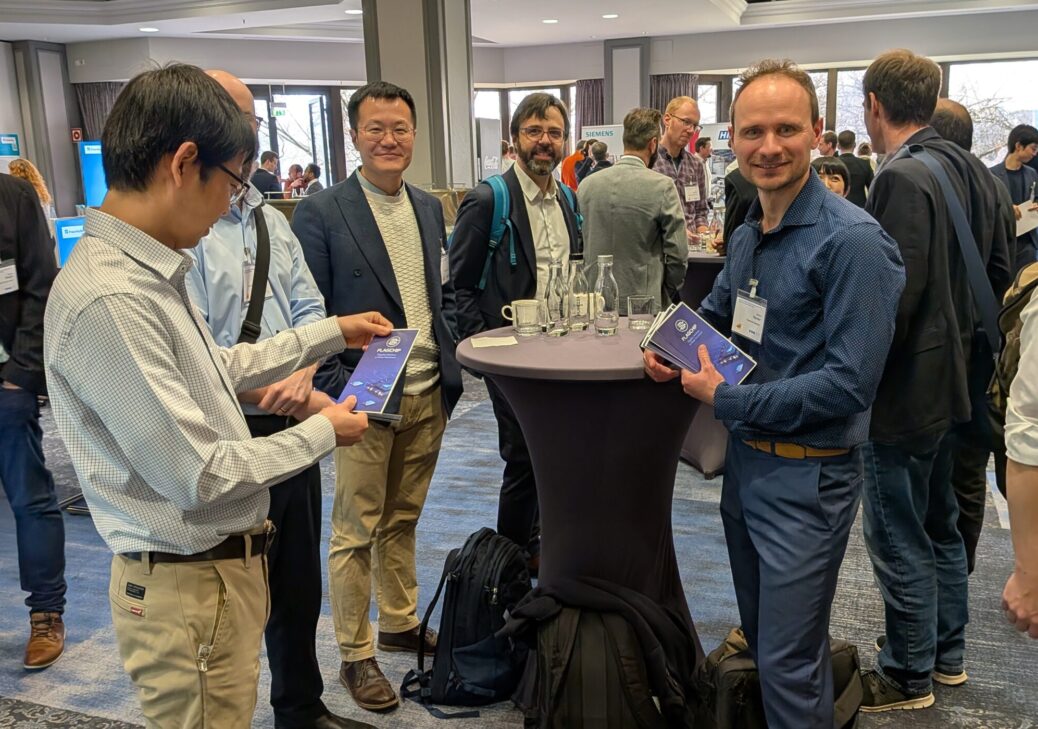
FLAGCHIP Partners Showcase Research at CIPS 2026
Last week, project partners Kempten University of Applied Sciences and University of Nottingham actively participated in the CIPS 2026, contributing to key discussions on the future of power electronics and advanced module design.
At the conference, much discussion focused on wide bandgap power devices and the challenges and opportunities they bring. In particular, the University of Nottingham contributed to in-depth discussions on wide bandgap power devices, with a particular focus on gallium nitride (GaN) technologies. Prof. Ke Li was invited to present on the stability challenges associated with GaN devices, which, despite their advantages in switching speed, introduce increased noise and operational complexity. The presentation attracted significant interest from conference participants.
Johann Renner from HKE presenting at CIPS 2026
Johann Renner from Kempten University highlighted the transformative potential of dielectric cooling strategies in power module design. By moving beyond conventional cooling approaches, these methods offer pathways toward significantly higher power densities and enhanced thermal management. However, challenges remain—particularly in low-temperature environments, where oil- and ester-based coolants experience sharp increases in viscosity. This can place additional strain on cooling systems, requiring higher pumping power and more complex configurations. Current research at Kempten is addressing these issues by evaluating the performance of multiple dielectric fluids across a wide temperature range, from -20°C to 60°C. Such work is critical for ensuring the efficiency and reliability of next-generation power electronics under diverse operating conditions.
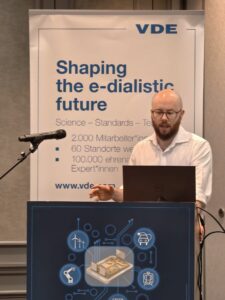
Mark Sherriff from UoN presenting at CIPS 2026
Further discussions explored emerging innovations, including monolithic bidirectional GaN switches for improved efficiency and simplified system architectures. Advances in reliability were also a key theme, with new combined simulation and stress-testing methodologies helping to reduce experimental time. Additionally, novel die attach techniques—particularly those emphasizing improved sintering processes and higher copper content—demonstrated promising progress in module design.
Condition monitoring remained a central topic throughout the conference, especially the accurate measurement and estimation of die junction temperature, with University of Nottingham and Mark Sherriff giving a presentation on the topic. Among the highlighted innovations was a screen-printed thermocouple developed by Fraunhofer Institute for Ceramic Technologies and Systems, enabling more precise thermal monitoring and sparking valuable discussion among attendees.
The strong presence of FLAGCHIP partners at CIPS 2026 underscores the project’s active role in addressing critical challenges and advancing innovation in power electronics.
Keep up with FLAGCHIP through its social media!
Facebook | X | LinkedIn | YouTube


